Jim Caviezel to young people: Send Lucifer back to hell
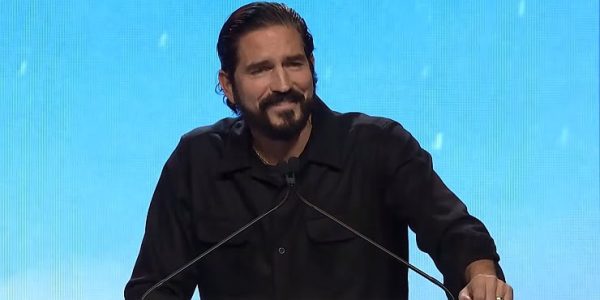
Jim Caviezel, in his latest film Paul, Apostle of Christ, which was released last spring, plays the evangelist Luke. To promote the film, he attended a gathering of FOCUS leaders at the SLS conference. The actor called on future generations to “send Lucifer back to hell.”
The gathered students may have expected the actor to speak about his film, but Caviezel’s speech was a phenomenal call to action that touched everyone, writes the Catholic portal Aleteia.
The audience was thrilled when they saw Caviezel, to the point that it seemed they would never calm down. He gently raised his finger, and the entire room fell silent. Then he began quietly and awkwardly reading from the paper on which he had his prepared speech:
“The name Saul means Great. The name Paul means Small. While filming this movie, I learned that if we change one small letter, we can become great in God’s eyes. But first, we must become small in order to become great. That is the path of the saints. That is the path of the Holy One, and the way Saul became St. Paul.”
He continued speaking about vocation and how a person must be open in order to discern that kind of calling. He spoke about how he knew he wanted to be an actor, about the stressful period when he played Edmond Dantès in The Count of Monte Cristo, and about how much he sacrificed while playing the role of Jesus in The Passion of the Christ.
“When I was on the cross, I learned that our redemption is in His suffering. Remember that the servant is not greater than
the master. Each of us must carry our own cross. There is a price for our faith and freedom. I was punished, scourged,
crucified, struck by lightning — yes, and I had open-heart surgery; that is what happens after five and a half months of hypothermia.”
He recalled a moment during the filming of The Passion of the Christ when he was pinned beneath the cross, and someone tried to pull out the pin the wrong way, dislocating his shoulder in the process. He said that moment remained in the final version of the film, adding that we would not have had the chance to see something like that if the movie had been filmed in a studio.
“Suffering was the main characteristic of my performance, and it plays the same role in our lives.”
“There was much pain and suffering before the Resurrection. Your path will be no different. Embrace your cross and set your sights on your
your goal. I want you to go out into this pagan world and shamelessly profess your faith in public. The world needs proud
warriors guided by faith — warriors like St. Paul and St. Luke, who risked their names and reputations in order to show their faith and love for
Jesus to the world.”
He spoke about democracy and about how every person’s freedom to do what they want is not the same as the freedom to do anything at all. He quoted Maximilian Kolbe’s famous line: “Indifference is the greatest sin of the 20th century,” and then added: “Well, my brothers and sisters, it is the greatest sin of the 21st century as well.”
The speech ended by quoting the famous speech from the film Braveheart, in which William Wallace encourages his army by speaking about freedom and what a man must be willing to do for it. In conclusion, he added:
“Every man dies. But not every man truly lives. You, you, you. We must all fight for true freedom and live, my friends…”
my friends. We must live! With the Holy Spirit as your shield and Christ as your sword, you can join Saint
Michael and all the angels in sending Lucifer and all his followers straight back to hell, where they belong!”
It is interesting to observe the change in Caviezel when he stops following his prepared speech and gives himself over to a spontaneous delivery, as if visually showing the difference between “Great” and “Small.” When he finished, he leaned over the stage and smiled awkwardly when he realized that he had departed from his prepared words.